 Mentis
- Four plans: Sleep, Overthinking, Relationships and Work stress.
- Nine chapters each, about 3–4 weeks, 5–10 minutes a day.
- Every chapter teaches one skill and gives you one small habit that the daily check-in tracks.
- Built on well-studied techniques, like CBT-I for sleep and worry postponement for overthinking, written for Indian homes and work weeks.
Deep Sleep Reset
For nights that fight back
Quiet the Overthinking
For minds that will not sit down
Closer Relationships
For feeling less alone with the people you have
Burnout Recovery
For the overburdened
What is a Mentis plan?
A Mentis plan is a short, structured path through one area of your life that's been hard lately. Instead of a hundred tips, you get nine chapters in a set order. Each chapter has a clear goal in your own words, like "I wake at the same time, even after a bad night" or "I can put a thought down and come back to it later."
Inside each chapter there's a mix of short reads, guided audio, journaling, small real-world steps and one keystone habit. The keystone is the one thing the chapter is really about. Mimi asks about it in your morning or evening check-in, and the chapter is done when the habit is holding on most days, not when you've ticked boxes.
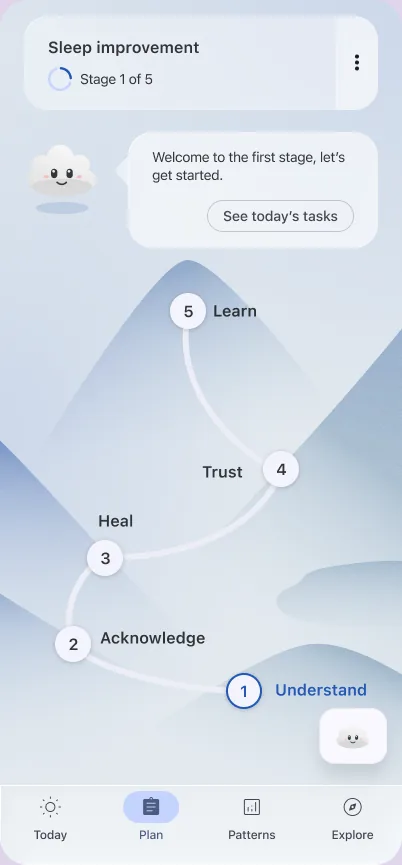
How does a plan fit into a busy day?
Most days ask for 5–10 minutes. A typical day looks like this:
- Morning check-in (2 minutes). Mimi asks how you're arriving into today and one question about your keystone habit.
- Today's task (3–5 minutes). One short read, audio, journal prompt or small step from your chapter.
- The habit itself. Something you do anyway, done slightly differently. Getting up at a set time. Closing the laptop with tomorrow's first step written down.
- Evening reflection (optional, 1 minute). How it went, in a line or two. Mimi uses it to spot patterns.
Why small habits instead of big changes?
Because small habits are the ones that last. In a well-known study of how habits form in real life, a new daily behaviour took a median of 66 days to become automatic, and missing a single day didn't derail it (Lally et al., 2010). That's why every Mentis chapter builds one habit at a time, keeps going when you slip, and only moves on when the habit is holding.
What research are the plans built on?
Each plan is written from techniques that have been studied for decades, then turned into short, everyday steps:
- Sleep: stimulus control, a fixed wake time, sleep regularity, caffeine timing and the worry list, the core pieces of CBT for insomnia (CBT-I).
- Overthinking: worry postponement, rumination-focused techniques ("how, not why"), concreteness training, self-compassion and applied relaxation.
- Relationships: small, regular contact, reciprocity, saying the real thing and asking for help. Research keeps finding that people underestimate how welcome these are.
- Work stress: psychological detachment after work, single-tasking, workload clarity, sense of control and recognition, the factors burnout research points to again and again.
Which plan should I start with?
Start with the one that's costing you the most right now. If you're not sure, the first few check-ins will tell you. Mentis shows your Sleep, Social, Work and Lifestyle "skies" separately, so you can see which one has been stormy all week. Many people start with Sleep, because better nights make everything else easier to work on.
Lying awake, or waking at 3am?
Start with Deep Sleep Reset.
Replaying, what-iffing, can't decide?
Start with the Overthinking plan.
Lonely, even with people around?
Start with Closer Relationships.
Work never ends, and you're running on empty?
Start with Burnout Recovery.
What if life gets in the way?
It will, and the plans expect it. If you miss a few days, your plan moves into a short recovery stretch with lighter tasks, then picks up where you left off. At the end of every plan, the last chapter, "Holding it", helps you choose which habits to keep and write your own early-warning sign and restart rule. You leave with a playbook, not a dependency on the app.
Frequently asked questions
How long does a Mentis plan take?
Each plan has nine chapters and usually takes three to four weeks at a few minutes a day. You move on when a habit is holding, not when a timer runs out, so some people take a little longer.
Can I do more than one plan at a time?
We suggest one at a time. Each plan builds small habits that need a couple of weeks to settle, and stacking two plans usually means neither sticks. When you finish one, Mimi suggests the next area based on your check-ins.
What happens if I miss a few days?
Nothing breaks. The plan notices, shifts into a short recovery stretch, and picks up where you left off. Missing days is normal, and the plan is built around it.
Are the plans free?
Mentis is free to download, and you can start a plan and see how it works before deciding on anything else in the app.
Is a Mentis plan the same as therapy?
No. A plan is a self-help wellness programme built on techniques that research has tested, like CBT-I for sleep and worry postponement for overthinking. It is not medical care. If you're struggling a lot, please talk to a qualified professional or call Tele-MANAS on 14416.
- Trauer JM et al. (2015). Cognitive behavioral therapy for chronic insomnia: a systematic review and meta-analysis. Annals of Internal Medicine 163(3).
- McGowan SK, Behar E (2013). A preliminary investigation of stimulus control training for worry. Behavior Modification 37(1).
- Lally P et al. (2010). How are habits formed: modelling habit formation in the real world. European Journal of Social Psychology 40(6).
- Holt-Lunstad J, Smith TB, Layton JB (2010). Social relationships and mortality risk: a meta-analytic review. PLoS Medicine 7(7).