 Mentis
- A guided sleep plan with 9 chapters, about 3–4 weeks, 5–10 minutes a day.
- Built on CBT-I, the approach sleep researchers recommend first for long-running insomnia.
- Covers a steady wake time, the hour before bed, chai and coffee, shared rooms, the bed-means-sleep rule, weekends and the 3am mind.
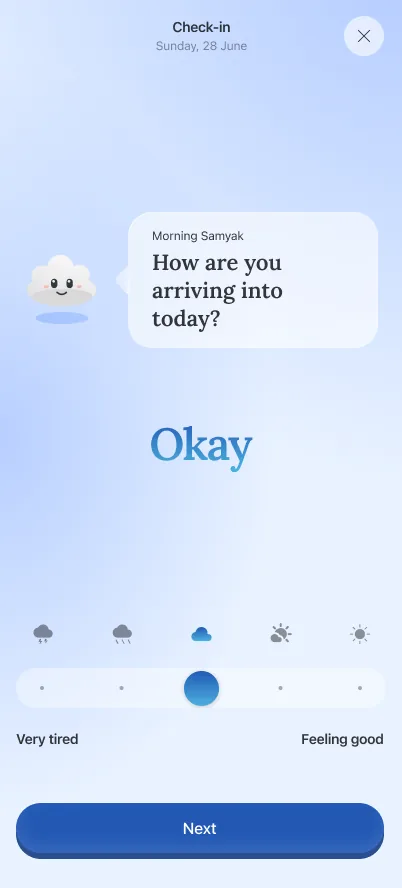
- No tracker needed. Mimi asks one line about last night in your morning check-in.
Who is the sleep plan for?
Deep Sleep Reset is for you if most weeks look like this: you're exhausted at 6pm and wide awake at midnight, the phone gets "five more minutes" that turn into an hour, Sunday's lie-in leaves Monday heavier, and some nights your mind switches on at 3am and won't switch off. It's for ordinary, stubborn bad sleep: the kind that comes from habits, stress and a body clock that's drifted. It isn't for sleep problems with a medical cause (see the FAQ).
Why does it work when sleep tips don't?
Most sleep advice is a list: no screens, warm milk, lavender. Deep Sleep Reset is built on cognitive behavioural therapy for insomnia (CBT-I), the most-studied non-drug approach to poor sleep. In a meta-analysis of 20 trials, CBT-I helped people fall asleep about 19 minutes faster and cut time awake during the night by about 26 minutes (Trauer et al., 2015). The gains held after the programmes ended.
CBT-I works because it fixes the causes rather than the symptoms. It anchors your body clock with a fixed wake time, teaches your brain that bed means sleep again, and deals with the racing mind that keeps you up. The plan takes those pieces and turns them into one small habit at a time.
What's in the 9 chapters?
1. The first honest look
Nothing to fix yet. For a week you fill in a rough line about last night, so you can see what your nights actually look like rather than what they feel like. Activities include "Fill In Last Night, Roughly", "One Bad Night Isn't A Verdict" and a short health check, "Five Health Questions And A Snore Check".
2. A time I wake up
Goal: I wake at the same time, even after a bad night. The wake time is the strongest lever you have, so it comes first. You pick a time you can hold, put the alarm across the room, and get daylight before the phone. Activities: "Why Catching Up Never Works", "Let The Light In Before The Alarm". See the fixed wake time and morning light.
3. The hour before bed
Goal: The hour before bed belongs to me again. It isn't really the blue light, it's the scrolling. You choose where the phone sleeps and set up an "evening switch", one thing that tells your body the day is over. Activities: "It Isn't The Blue Light, It's The Scrolling", "The First Night Face Down", and a warm shower before bed.
4. Nothing borrowed
Goal: Chai, coffee and drinks aren't running my nights. You count back eight hours from bedtime, find the hidden caffeine, and set a cut-off. Activities: "The 3 PM Chai Is Still In You At 11", "Every Cup, Today", "The Cup Nobody Counts". See the caffeine cut-off.
5. Someone else's night
Goal: I've made my sleep workable inside a shared room. This one is for Indian homes: a snoring partner, a child in the bed, parents watching TV late. You set up your side, walk your room in the dark, and make one ask. Activities: "Decide Your Side", "The Room With Three People In It", "The One Ask".
6. Bed means sleep
Goal: My bed is for sleeping, and my body knows it. This is stimulus control, the core of CBT-I. Lie down only when sleepy, get up if you can't sleep, and keep to a sleep window. Activities: "How The Bed Learned To Keep You Awake", "Hide The Clock", "Get-Up Rehearsal". See the get-up rule and hide the clock.
7. No more weekend debt
Goal: My weekends don't wreck my Mondays anymore. Sunday night is jet lag. You bring the weekend alarm within an hour of the weekday one and set a bedtime alarm to start winding down. Activities: "Sunday Night Is Jet Lag", "Regular Beats Long, So Here's What You Do".
8. The 3am mind
Goal: When my mind switches on at night, I know what to do. An evening worry list empties the mind before bed, and a short 3am routine tells you exactly what to do if you wake. Activities: "Waking At 3 Isn't The Problem", "The Night It Didn't Take Hold", and The 3 AM Thoughts, At 10 AM. See also the brain dump before bed.
9. Holding it
Goal: I can keep this without the app holding my hand. You choose your keepers, write your own one-page sleep playbook, and set a restart rule for the next bad patch. Activities: "Everything You Learned, In One Page", "My Sleep Playbook".
What does a day on the plan look like?
- At the alarm. Up at your set time, feet on the floor, curtain open. Your check-in asks if you made it.
- Sometime in the day (3–5 minutes). One short read, audio or journal prompt from your chapter.
- Evening. Your evening switch, and the worry list once you reach chapter 8.
- If you wake in the night. The 3am routine. No clock-checking, and no lying there fighting it.
What changes can I expect?
Most people notice the first change in the mornings: getting up at a set time stops being a fight within a week or two, and sleepiness starts turning up at a predictable time at night. Falling asleep tends to get easier around the middle of the plan, after the bed-means-sleep chapter. The 3am wake-ups often don't vanish, but they stop turning into hours. Sleep regularity matters a lot for long-term health, too: in a study of over 60,000 people, regular sleep timing predicted lower mortality risk more strongly than sleep length did (Windred et al., 2024).
Some weeks will feel worse before they feel better, especially in chapter 6, when you get out of bed instead of lying awake. That's expected, and Mimi will tell you when it happens.
How do I start the sleep plan?
Download Mentis, do your first check-in, and choose Sleep. If your Sleep sky has been stormy, Mimi will usually suggest it for you. The plan starts the next morning with chapter 1. Want to try a piece today? Start with a fixed wake time, or read our guide to sleeping better.
Frequently asked questions
Is this a sleep tracker?
No. Mentis doesn't need a watch or a tracker. A rough line about last night in your morning check-in is enough. Research on 'orthosomnia' suggests that chasing perfect tracker numbers can make sleep worse, so the plan keeps it light.
How is this different from a sleep sounds or meditation app?
Sleep sounds help you relax tonight. Deep Sleep Reset changes the habits that decide how you sleep every night: when you get up, what the last hour looks like, caffeine timing, what you do when you can't sleep. Guided audio is part of it, but it isn't the whole plan.
Will it work if I share a room or bed?
Yes. A whole chapter, 'Someone else's night', is about sleeping well in a shared room: snoring, a partner on a different schedule, kids, or family who are up late.
What if I do shift work?
The plan works around a fixed wake time, so you set it to fit your shifts. If your schedule rotates often, start with chapters 1, 3 and 8, and talk to a doctor if sleepiness affects your safety at work.
When should I see a doctor about sleep?
If you snore loudly and wake gasping, feel very sleepy while driving, have restless legs at night, or poor sleep has lasted months despite good habits, please see a doctor. Chapter 1 includes a short health check for these signs.
- Trauer JM et al. (2015). Cognitive behavioral therapy for chronic insomnia: a systematic review and meta-analysis. Annals of Internal Medicine 163(3).
- Morin CM et al. (2006). Psychological and behavioral treatment of insomnia: update of the recent evidence. Sleep 29(11).
- Windred DP et al. (2024). Sleep regularity is a stronger predictor of mortality risk than sleep duration. Sleep 47(1).
- Drake C et al. (2013). Caffeine effects on sleep taken 0, 3, or 6 hours before going to bed. Journal of Clinical Sleep Medicine 9(11).
- Haghayegh S et al. (2019). Before-bedtime passive body heating by warm shower or bath to improve sleep: a systematic review and meta-analysis. Sleep Medicine Reviews 46.
- Scullin MK et al. (2018). The effects of bedtime writing on difficulty falling asleep. Journal of Experimental Psychology: General 147(1).