 Mentis
- Fix your wake-up time first, seven days a week. It sets the body clock that decides when you feel sleepy.
- Give your mind an off-ramp: an hour before bed with dim light, no work and no news, and worries written down earlier in the evening.
- If you're awake in bed for what feels like 20 minutes, get up and come back when sleepy. This teaches your brain that bed means sleep.
- These are the core steps of CBT-I, the approach sleep researchers recommend first. In trials it helped people fall asleep around 19 minutes faster.
Why can't I sleep at night?
You can't sleep at night when the two systems that run sleep fall out of step. The first is sleep pressure, a need for sleep that builds every hour you're awake. The second is your body clock, which decides when in the 24 hours you feel alert and when you feel drowsy. When they line up, sleep comes quickly. When they don't, you lie in the dark, tired and awake.
On top of that sits a third thing: arousal. A racing mind, a tense body or a bedroom your brain has learned to link with lying awake can all override sleep pressure. That's why you can be exhausted all day and wide awake at midnight.
The most common reasons sleep won't come
1. Your wake time moves around
A 7am alarm on weekdays and 10am on Sunday is, to your body clock, a short flight to another time zone every weekend. Researchers call it social jetlag. It pushes your sleepy time later, so on Sunday night you lie awake. A 2024 study of over 60,000 people found that sleep regularity predicted health outcomes more strongly than sleep length. Read more in weekend sleep debt and social jetlag.
2. Your mind is still at work
Bedtime is often the first quiet moment of the day, so every unanswered message, tomorrow's meeting and the thing you said in 2019 arrive at once. If this is you, start with overthinking at night and the worry timer.
3. Your bed has become a place for being awake
Scroll, reply to work, watch a series and toss for an hour, and your brain learns that bed is for being alert. Stimulus control, developed by Richard Bootzin in the 1970s, reverses that: bed is only for sleep, and you leave it when you can't sleep.
4. Something borrowed is still in your system
Caffeine has a half-life of around five to six hours. A cutting chai at 5pm is still partly working at 11pm. Alcohol makes you drowsy but breaks up the second half of the night. See caffeine and sleep.
5. Light at the wrong times
Too little daylight in the morning and too much bright screen light at night both shift your clock later. Phones before bed do this, and they keep your mind switched on.
6. Worry about sleep itself
After a few bad nights, bedtime starts to feel like a test. Checking the clock and calculating "if I fall asleep now I get five hours" adds pressure that keeps you awake. This is sleep anxiety, and it's very common.
What should I do if I can't sleep right now?
If you're reading this at night, try this. Don't force sleep. Make being awake calmer and less important.
- Put the clock out of sight. Turn the phone face down, out of reach. Knowing the time only feeds the countdown.
- Slow your breathing. Breathe in for 4 and out for 6 to 8, for a few minutes. Our 4-7-8 breathing timer counts it for you.
- If you're still wide awake after what feels like 20 minutes, get up. Go to a dim room and do something quiet and dull: fold clothes, read a paper book, listen to something gentle. Return to bed when your eyes feel heavy.
- Park the thoughts. If your mind keeps running, write the thoughts down with one next step each. You've done what you can for tonight.
- Get up at your usual time tomorrow, however the night went. This is the step that fixes next week.

How do I fix my sleep long term?
The approach with the strongest research behind it is CBT-I (cognitive behavioural techniques for insomnia). The American Academy of Sleep Medicine's 2021 guideline recommends it as the first step for adults with long-term sleep problems, ahead of sleeping pills. Its pieces are simple. The hard part is doing them steadily for a few weeks.
| Step | What you do | Why it works |
|---|---|---|
| A fixed wake time | Same time daily, weekends included. Daylight within an hour. | Anchors the body clock so sleepiness arrives at a predictable hour. |
| A wind-down hour | Dim lights, no work, no news, something calm and repeatable. | Lets arousal fall before you lie down. |
| Bed means sleep | Bed only for sleep (and intimacy). Get up if awake about 20 minutes. | Rebuilds the link between bed and sleeping. |
| Nothing borrowed | Caffeine before about 2pm, alcohol light and early. | Removes chemicals that delay or break up sleep. |
| Worry earlier | 15 minutes of written worry in the early evening. | Keeps problem-solving out of bedtime. |
| Warm shower | A warm shower or bath 1–2 hours before bed. | The cool-down afterwards helps you fall asleep sooner (Haghayegh, 2019). |
For the full protocol, see how to fix your sleep schedule. If you want something for tonight, how to fall asleep fast covers quick techniques.
How the Mentis Sleep plan helps
The Deep Sleep Reset plan turns these steps into nine short chapters, a few minutes a day for three to four weeks. You start with The first honest look, a week of noticing your real sleep. Then A time I wake up, The hour before bed, Nothing borrowed and Bed means sleep, ending with The 3am mind and Holding it, so the changes last.
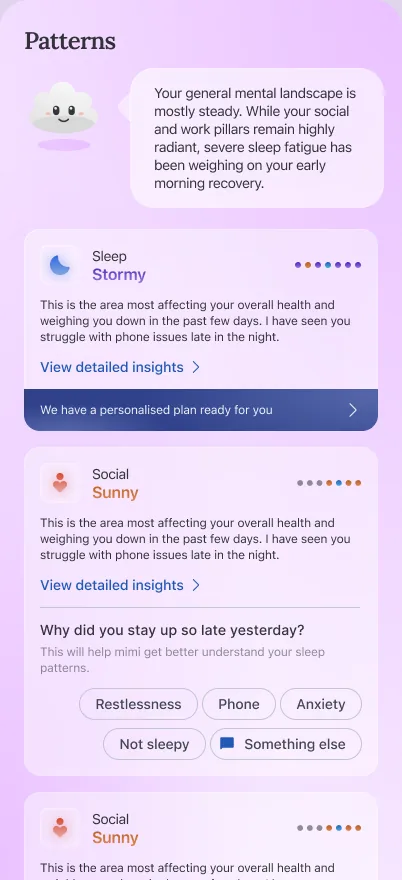
Each chapter has small activities like "Pick A Wake-Up Time You Can Hold", "Let The Light In Before The Alarm", "Hide The Clock", "Try A Warm Shower Before Bed" and the guided audio "Winding Down, Guided". Your daily check-in shows your Sleep sky (Sunny, Cloudy, Stormy), and Mimi points out patterns, like late screens showing up in your morning mood.
When poor sleep needs a doctor
Self-help steps work for most everyday sleep trouble. See a doctor if you snore loudly or someone notices you stop breathing at night, you fall asleep at the wheel or in meetings, your legs feel restless in the evening, poor sleep has lasted more than three months, or it comes with a low mood that won't lift. These can point to conditions like sleep apnoea or depression, which need a proper check.
Sleep guides
How to fall asleep fast
Slow breathing, cognitive shuffling, the cool-down trick and more.
Fix your sleep schedule
Reset a late or messy sleep schedule in one to two weeks, starting with your wake time.
Waking up at 3am
Why you wake in the small hours, and how to drift back instead of spiralling.
Overthinking at night
Why thoughts get loud at bedtime, and how to move them out of the bed.
Sleep anxiety
When bedtime feels like a test, and how to take the pressure off.
Weekend sleep debt
Why sleeping in on Sunday makes Monday feel like jetlag, and what to do instead.
Phone before bed
Blue light is only part of it. What scrolling does to sleep, and a realistic way to stop.
Caffeine and sleep
How long caffeine lasts, and the cut-off time that protects your night.
Night shift sleep
Sleeping well in the day after nights at a BPO, hospital or global team.
Frequently asked questions
Why can't I sleep at night even when I'm tired?
Being tired and being ready to sleep are different. Tiredness builds through the day, but your body clock and a busy mind can keep you alert at bedtime. An irregular wake time, late caffeine, screens and worry are the usual reasons the two don't line up.
What should I do if I can't sleep at night?
If you've been awake for what feels like 20 minutes, get up, go somewhere dim and do something calm until you feel sleepy, then return to bed. Keep the same wake time the next morning, however the night went.
How many hours of sleep do adults need?
Most adults need 7 to 9 hours. Consistency matters as much as the number: a regular sleep and wake time is linked with better health than long but irregular sleep.
Is it okay to take a nap if I slept badly?
A short nap of 20 minutes before about 3pm is usually fine. Long or late naps reduce sleep pressure and can make the next night harder.
When should I see a doctor about sleep?
See a doctor if poor sleep lasts more than three months, if you snore loudly or stop breathing in your sleep, if you fall asleep during the day without meaning to, or if low mood comes with it.
- Trauer JM et al. (2015). Cognitive behavioral therapy for chronic insomnia: a systematic review and meta-analysis. Annals of Internal Medicine 163(3).
- Edinger JD et al. (2021). Behavioral and psychological treatments for chronic insomnia disorder in adults: an AASM clinical practice guideline. J Clin Sleep Med 17(2).
- Windred DP et al. (2024). Sleep regularity is a stronger predictor of mortality risk than sleep duration. Sleep 47(1).
- Drake C et al. (2013). Caffeine effects on sleep taken 0, 3, or 6 hours before going to bed. J Clin Sleep Med 9(11).
- Bootzin RR (1972). Stimulus control treatment for insomnia. Proceedings of the APA.
- Haghayegh S et al. (2019). Before-bedtime passive body heating by warm shower or bath to improve sleep. Sleep Medicine Reviews 46.