 Mentis
- A 9-chapter burnout recovery plan, about 3–4 weeks.
- Covers the edges of the day (where work stops), the inside of the day (one thing at a time, steady when it spikes) and what makes work feel worth it (say, progress, support).
- Built on recovery and burnout research, and written for Indian work weeks: long hours, late calls, WhatsApp groups and managers who message at 10pm.
- Honest about what an app can't change.
Who is the work stress plan for?
You close the laptop at 9 and think about work till 1. You answer messages from bed. Every day is full but you can't say what you finished. A sharp email at 11am takes the rest of the day with it. If that sounds like your week, Burnout Recovery is for you. It's also for the "I'm fine, just tired" stage, before it gets worse.
How common is burnout in India?
Very. In McKinsey Health Institute's 2023 survey of employees across 30 countries, 59% of Indian respondents reported burnout symptoms, among the highest of any country surveyed. The World Health Organization recognises burnout as an occupational phenomenon in ICD-11: exhaustion, mental distance from your job, and reduced effectiveness, caused by chronic workplace stress that hasn't been managed.
Why does this plan work?
Burnout research keeps pointing to the same handful of things: psychological detachment after work (Sonnentag & Fritz, 2007), focus without constant switching (switching leaves "attention residue", Leroy 2009), a realistic load, some say over how work is done, recognition, and support. Each chapter takes one of these and gives you one small habit for it. For example, writing tomorrow's first step before you close the laptop works because a concrete plan for an unfinished task stops it nagging at you (Masicampo & Baumeister, 2011).
What's in the 9 chapters?
1. The first honest look
Goal: I can see what my work is actually asking of me. Log your real finish time, and do a six-area work-fit check. Activities: "What Your Work Is Actually Asking Of You", "A Bad Patch, Or How The Job Is", "Walk Through One Bad Day", "Two Sighs".
2. Where work stops
Goal: Work ends when I say it ends. A finish time you can hold, tomorrow's first step written down, and replies that wait till morning. Activities: "Why Work Doesn't End On Its Own", "The Walk That Ends The Day", "Park Tomorrow's Worries On Paper". See shut the laptop properly.
3. One thing at a time
Goal: I can hold one thing for an hour without fracturing. Tomorrow's one thing, the phone in another room, and one line before switching. Activities: "Why Busy Days Give You Nothing", "The Hour That Held", "Two Minutes Between Meetings". See step out between meetings.
4. What I'm carrying
Goal: I know my real load, and what I can put down. Everything in one place, with three items marked. Activities: "You Can't Change What You Can't Describe", "Why The List Is Smaller Than The Fear", "Given To Me, Taken On By Me".
5. Steady when it spikes
Goal: A hard hour doesn't take the whole day with it. Two minutes after lunch, and a plan for when it surges. Activities: "A Bad Hour Shouldn't Take The Day", "The Meeting That Didn't Take The Day", "Afternoon Daylight, Not The Fourth Chai".
6. Having a say
Goal: I have some say in how my work goes. One thing a day done your way, and one hour blocked before others fill it. Activities: "Some Say Isn't The Same As Control", "Below The Radar First", "Speaking Up Where The Boss Is The Boss". See in my hands, not in my hands.
7. It counts for something
Goal: The work registers, to me and to someone else. A daily progress line. Research on "small wins" found that progress on meaningful work was the biggest booster of people's inner work life (Amabile & Kramer, 2011). Activities: "Did, Not Mattered", "The Person At The End Of Your Work".
8. Not carrying it alone
Goal: There are people here I'd actually turn to. One true line to one person. Activities: "Why Alone Makes It Worse", "They'd Help More Than You Think", "The One Accurate Sentence To Your Manager".
9. Holding it
Goal: Work is something I do, not something I am. Keep the close, keep your skills, and write your work manual and early-warning sign. Activities: "Work Is Something You Do", "My Work Manual".
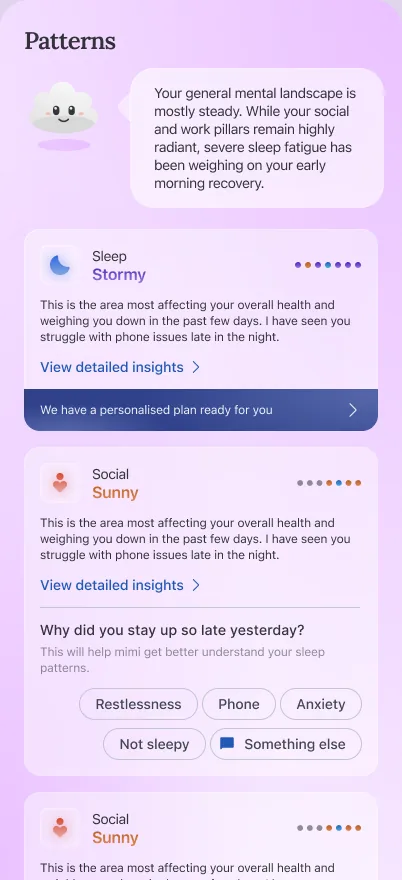
What does a day on the plan look like?
- Morning check-in (2 minutes). How you're arriving into today.
- First hour. Today's one thing, before the inbox.
- Between meetings. Two minutes, two sighs, a far point.
- At your finish time. Write tomorrow's first step, close the laptop, take the walk.
What changes can I expect?
Usually, evenings change first: within a week or two of chapter 2, work thoughts after your finish time get quieter. The middle chapters make the day itself feel less scattered. The last chapters are slower, because they're about meaning and support. Your workload may not shrink, but you should feel less run by it. If nothing improves after the plan, that's useful information too, and chapter 1's work-fit check helps you think about what to do next.
How do I start?
Download Mentis, do your first check-in and choose Work. Or start tonight with shutting the laptop properly. You can also read our guides to work stress.
Frequently asked questions
Can an app really help with burnout?
An app can't change your manager or your workload, and the plan is honest about that. What it can do is help with the parts research links to recovery: switching off after work, single-tasking, seeing your real load, a sense of control, recognition and support. Many people find these make a demanding job more liveable. If burnout comes with feeling hopeless or unable to function, please see a professional.
What's the difference between stress and burnout?
Stress is usually too much: too many demands, and you feel you'd be fine if you could just catch up. Burnout is more like empty: exhaustion, feeling distant or cynical about work, and feeling less effective. The WHO describes burnout as an occupational phenomenon caused by chronic workplace stress that hasn't been managed.
I work in IT with US hours. Will this work for me?
Yes. You set your own finish time in chapter 2, and it doesn't have to be 6pm. The plan is about having an edge to the day, wherever it falls.
Will my employer see my data?
No. Mentis is a personal app. Nothing you write is shared with your employer.
Should I just quit?
Sometimes leaving is the right call, and the plan doesn't pretend otherwise. Chapter 1 helps you tell a bad patch from how the job really is, which makes that decision clearer either way.
- McKinsey Health Institute (2023). Working nine to thrive / Asia employee health survey: burnout symptoms by country.
- World Health Organization (2019). Burn-out an 'occupational phenomenon': International Classification of Diseases.
- Sonnentag S, Fritz C (2007). The Recovery Experience Questionnaire. Journal of Occupational Health Psychology 12(3).
- Leroy S (2009). Why is it so hard to do my work? The challenge of attention residue when switching between work tasks. Organizational Behavior and Human Decision Processes 109(2).
- Masicampo EJ, Baumeister RF (2011). Consider it done! Plan making can eliminate the cognitive effects of unfulfilled goals. Journal of Personality and Social Psychology 101(4).
- Amabile TM, Kramer SJ (2011). The power of small wins. Harvard Business Review.