 Mentis
- Burnout = exhaustion + cynicism + feeling ineffective, caused by long-term work stress (WHO, 2019).
- 59% of Indian employees reported burnout symptoms in a McKinsey Health Institute survey, among the highest of the countries studied.
- Rest helps, but recovery lasts only when the conditions change: where work stops, how much you carry, how much say you have.
- Switching off mentally after work is one of the strongest protections against burnout.
What is burnout at work?
In 2019 the World Health Organization included burnout in its International Classification of Diseases as an occupational phenomenon, not a medical condition. It defined it as the result of chronic workplace stress that hasn't been successfully managed, with three dimensions:
- Exhaustion: feeling drained and depleted, with nothing left in the tank.
- Mental distance: cynicism or negativity about your job, feeling detached.
- Reduced efficacy: feeling you're not getting anything done, or that your work doesn't matter.
These come from decades of research by psychologist Christina Maslach, whose work shows burnout grows from a mismatch between people and their jobs: too much workload, too little control, too little reward or recognition, poor relationships at work, unfairness, or a clash of values.
What are the signs of burnout?
- Waking up already tired, and Sunday evenings filled with dread. See the Sunday scaries.
- Cynicism: "what's the point", "nobody cares anyway".
- Struggling to focus, forgetting things, making mistakes.
- Irritability with colleagues and family.
- Can't switch off: checking Slack, Teams or email at 11pm.
- Headaches, stomach trouble, frequent colds, poor sleep.
- Pulling away from friends and things you used to enjoy.
For the full list and a quick self-check, read 12 signs of burnout. Not sure if it's burnout or ordinary stress? See burnout vs stress.
Why is burnout so common in India?
Long hours are normal in many Indian workplaces, especially IT, consulting, finance, startups and healthcare. Long commutes add two or three hours a day in big cities. Teams working with US or European clients take late-night calls. Phones keep work alive at all hours, and there's a strong culture of being always available. Add family responsibilities and financial pressure, and the load rarely lets up. The public "70-hour work week" debate in 2023 showed how divided opinion is. Our data piece, work-life balance in India, puts the numbers together.
How do I recover from burnout?
- Take an honest look. For one week, notice your real hours, when you check messages, what drains you and what doesn't. The Mentis journal "This Week, In Hours" starts here.
- Decide where work stops. Set a finish time you can hold, and an off-hours line for messages. Research by Sabine Sonnentag shows that mentally detaching from work in your free time is one of the strongest protections against exhaustion. See how to switch off after work.
- One thing at a time. Multitasking feels productive but leaves your attention scattered. Pick tomorrow's one important thing the evening before, and protect a focus block for it. See feeling overwhelmed at work.
- Sort what you're carrying. Separate what's truly yours from what you've taken on, and what's urgent from what isn't.
- Stay steady when it spikes. Deadlines and crises will come. Have a plan: a two-minute breathing reset, a short walk, and an "if-then" rule for spike weeks.
- Get more say. Burnout grows with low control. Renegotiate one thing: a deadline, a meeting, a priority. See talking to your manager.
- Make it count. Notice the work that matters and the people it helps. Recognition, including your own, protects against cynicism.
- Don't carry it alone. Talk to a colleague, a friend or your family. Ask for one specific thing.

When burnout needs more support
If exhaustion and low mood spread beyond work, if you feel hopeless, or if you have physical symptoms like chest pain or very poor sleep, see a doctor. Our low mood self-check and anxiety self-check can help you decide. In distress, call Tele-MANAS on 14416, free and 24×7.
How the Mentis Work stress plan helps
The Burnout Recovery plan follows the steps above in nine chapters, a few minutes a day for three to four weeks: The first honest look, Where work stops, One thing at a time, What I'm carrying, Steady when it spikes, Having a say, It counts for something, Not carrying it alone and Holding it.
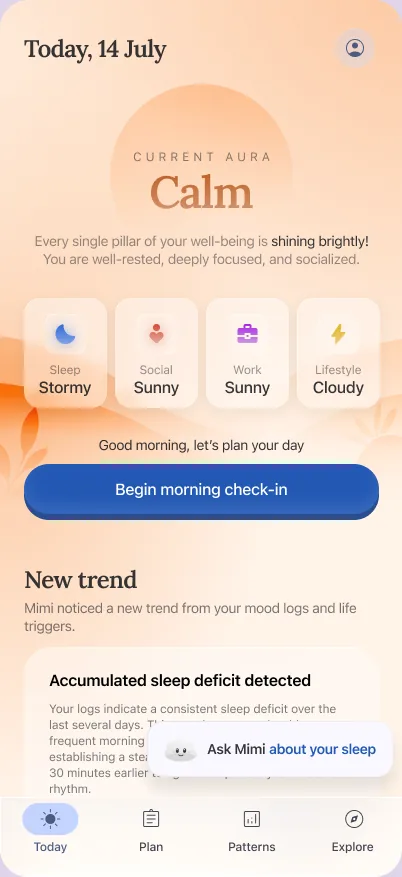
Activities include "Pick A Finish Time You Can Hold", "Shut The Laptop Properly", "Step Out Between Meetings", "Ninety Seconds Before You Go In", "Lunch Away From The Desk, Outside" and "Ask One Thing You Assumed Is A No". Your daily check-in tracks your Work sky, and Mimi points out patterns, like how late calls show up in your next-morning mood.
Work stress guides
Signs of burnout
Twelve warning signs across body, mind and behaviour, plus a quick self-check.
Burnout vs stress
Too much vs not enough: how to tell stress from burnout, and what helps each.
Toxic workplace
Signs the culture is the problem, how to protect yourself, and how to plan an exit.
Work-life balance in India
The numbers on Indian work stress, from burnout to long hours, and what helps.
Switch off after work
A shutdown routine that leaves work at work, even at home.
Sunday scaries
That sinking Sunday feeling, what it tells you, and a routine that softens it.
Overwhelmed at work
Too much on your plate? Sort the load, pick one thing, and calm the spike.
Manager stress
Micromanaged, overloaded or ignored: scripts and steps for a calmer working relationship.
Frequently asked questions
What is burnout?
The WHO describes burnout as an occupational phenomenon resulting from chronic workplace stress that has not been successfully managed. It has three parts: exhaustion, mental distance or cynicism about your job, and reduced professional efficacy.
How do I know if I'm burnt out or just tired?
Tiredness lifts after a good weekend or a holiday. Burnout tends to stay: you dread work, feel detached or cynical about it, and your effort doesn't feel like it makes a difference.
How long does it take to recover from burnout?
It varies. Mild burnout can ease in a few weeks with real changes to workload and rest; deeper burnout can take months. Recovery depends on changing the conditions, not just taking a break.
Should I quit my job if I'm burnt out?
Not necessarily, and not in a rush. First try to change what you can: hours, boundaries, priorities, support. If the workplace is consistently toxic or your health is suffering, planning a move can be the right choice.
Is burnout the same as depression?
No, but they overlap. Burnout is tied to work; depression affects all areas of life. If you feel low, hopeless or lose interest in everything, not just work, take our low mood self-check and talk to a doctor.
- World Health Organization (2019). Burn-out an 'occupational phenomenon': International Classification of Diseases.
- McKinsey Health Institute (2023). Working nine to thrive / Asia employee health survey: burnout symptoms by country.
- World Health Organization (2024). Mental health at work: fact sheet (12 billion working days lost each year).
- Pega F et al. (2021). Global, regional, and national burdens of ischemic heart disease and stroke attributable to exposure to long working hours. Environment International 154.
- Maslach C & Leiter MP (2016). Understanding the burnout experience: recent research and its implications for psychiatry. World Psychiatry 15(2).
- Sonnentag S & Fritz C (2015). Recovery from job stress: the stressor-detachment model. Journal of Organizational Behavior 36(S1).