 Mentis
How it works
How Mentis works: two minutes in, one small step out
Mentis is built around a simple loop. Notice how you are, do one small thing that helps, and let the patterns teach you what to change. Here's each piece.
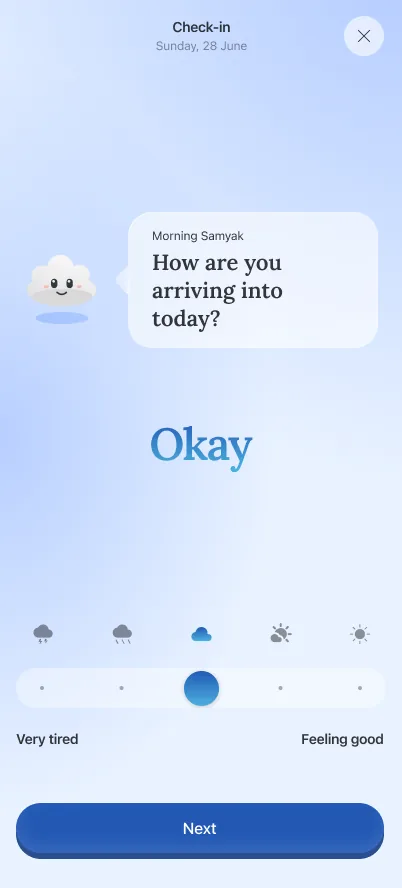
Step 1 · The check-in
A two-minute check-in with Mimi
Every morning Mimi asks one question that's easy to answer even on a bad day: how are you arriving into today? You slide from Very tired to Feeling good. Then come three to five quick taps about sleep, people, work and energy, and an optional line in your own words.
It works because naming a feeling is itself regulating. Studies of "affect labelling" (Lieberman et al., 2007) found that putting feelings into words reduced activity in the amygdala, the brain's alarm system. The check-in makes that a two-minute habit instead of a skill you have to remember under stress.
Step 2 · Your sky
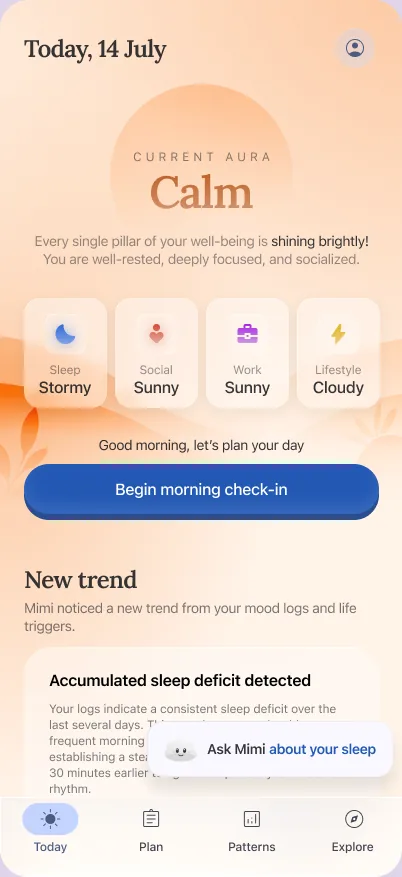
Your mood, shown as weather
Your answers turn into an aura for the day (Calm, Low energy, Quiet sky) and a separate sky for each area of life:
So instead of "I feel bad", you see "I'm doing fine socially and at work, but my sleep has been stormy all week", and you know exactly where to put your energy. Weather also takes the pressure off. A cloudy day isn't a failure; it's just today's weather.
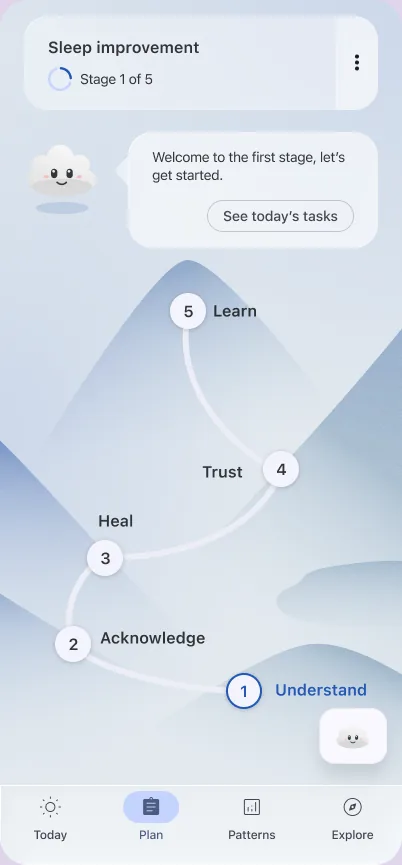
Step 3 · Your plan
A plan that gives you one small step a day
Pick the plan that matches what's heaviest: Sleep, Overthinking, Relationships or Work stress. Each one is nine chapters long, about three to four weeks, and each chapter is built around one change: a steady wake time, a worry window, saying the real thing, a finish time you can hold.
Every day the plan hands you one to three activities of three to ten minutes. There are more than 640 across the plans: guided audio, journaling, short reads, outdoor steps and habit check-ins. Miss a few days and the plan shifts into a gentler recovery mode instead of punishing you.
See all four plans →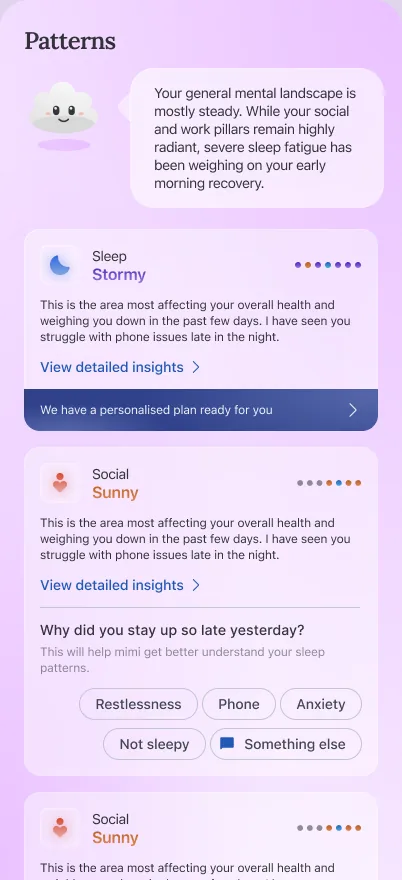
Step 4 · Patterns
Patterns that explain your week
After about three check-ins, Mimi starts telling you what it notices across your skies, in plain sentences: which days dip, what tends to come before a stormy night, which activities seem to lift you. As the weeks add up, these insights get more specific, and your plan uses them to suggest what to try next.

Any time · Mimi and Rant
Mimi, for the moments in between
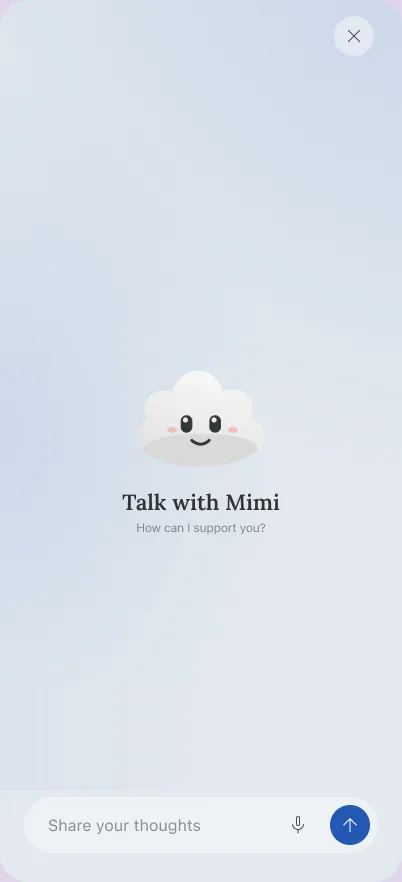
Some things can't wait for tomorrow's check-in. Open Mimi to think out loud, prepare for a hard conversation, or untangle a 2am spiral. Or use Rant: speak or type for as long as you need, and Mimi pulls out the themes so you can see what's actually weighing on you.
Mimi is an AI companion trained to listen, ask good questions and use the same techniques as your plan. It isn't a therapist, and if you seem to be in real distress it will point you to people who can help, like Tele-MANAS 14416.
The research
What Mentis is built on
CBT-I for sleep
Stimulus control, a fixed wake time and constructive worry: the core of cognitive behavioural therapy for insomnia, which meta-analyses show shortens time to fall asleep by about 19 minutes on average (Trauer et al., 2015).
Worry postponement
Setting aside a short, fixed window for worry. Research since Borkovec (1983) shows it reduces how much of the day worry takes up.
Self-compassion
Talking to yourself the way you'd talk to a friend. A meta-analysis of 27 trials (Ferrari et al., 2019) linked self-compassion training to lower rumination, stress and low mood.
Breathwork
Slow exhale-focused breathing like cyclic sighing, which improved mood more than mindfulness meditation in a 2023 Stanford trial (Balban et al.).
Mentis teaches self-help techniques for everyday wellbeing. It doesn't diagnose or treat any condition. Read our editorial policy.

Try tomorrow's check-in
Free to download on iPhone and Android.
Questions people ask
How does the Mentis check-in work?
Each morning Mimi asks how you're arriving into today on a simple slider from very tired to feeling good, then three to five quick questions about sleep, people, work and energy. It takes about two minutes. Evening reflections are optional.
What does the weather mean?
Mentis shows your mood as weather so it's easy to read: sunny, partly cloudy, cloudy, rainy or stormy. Each area of life (Sleep, Social, Work, Lifestyle) gets its own sky, and the current aura sums up today. Hazy means Mimi is still learning you.
How long until patterns show up?
Your aura appears from the first check-in. Mimi needs about three check-ins before it describes a trend, and a couple of weeks before it can say something with confidence. It tells you when it isn't sure yet.
What happens if I miss a few days?
Nothing breaks. Your plan notices and shifts into a lighter recovery mode so you can pick up where you left off, without starting again or feeling guilty.
Can I use Mentis without a plan?
Yes. The daily check-in, Mimi chat, rants and the Explore library of meditations, journaling, reads and outdoor activities all work on their own.