 Mentis
- Occasional bad nights: a relaxation app (sleep stories, sounds, breathing) is often enough.
- Bad nights for weeks: look for a CBT-I based program. In a 2015 meta-analysis it cut time to fall asleep by about 19 minutes and night-time waking by about 26 minutes.
- Trackers: useful for some, but can increase sleep worry ("orthosomnia").
The three kinds of sleep app
| Type | Examples | Helps with | Limits |
|---|---|---|---|
| Relax | Calm (Sleep Stories), Headspace (sleepcasts), Insight Timer | Winding down, replacing late-night scrolling | Doesn't change the habits keeping insomnia going |
| Track | Phone and watch sleep trackers | Seeing patterns over time | Can increase worry about sleep |
| Change habits (CBT-I) | Mentis Deep Sleep Reset | Irregular wake times, lying awake, the 3am mind, weekend sleep debt | Takes a few weeks of consistency |
Why habits matter more than sounds for long-term sleep
When sleep goes wrong for weeks, it's usually kept going by a loop: a bad night leads to sleeping in or napping, which weakens sleep drive the next night; lying awake in bed teaches the brain that bed is a place to worry; and worry about sleep makes the next night harder. CBT-I breaks each link. It's the approach recommended first for chronic insomnia by bodies including the American College of Physicians.
Indian lifestyles add their own pressures: late dinners, long commutes, late calls with overseas teams, and weekends that shift sleep by hours ("social jetlag"). A plan that works around those is more useful than a generic one.
How the Mentis Sleep plan works
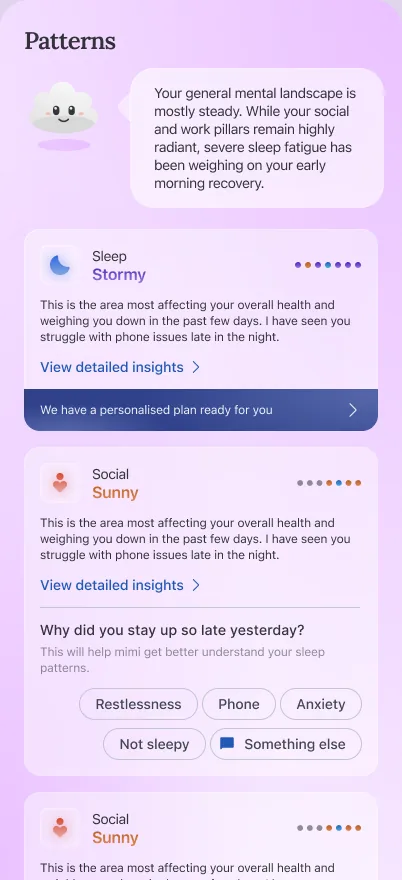
Deep Sleep Reset has nine chapters over 3–4 weeks: The first honest look, A time I wake up, The hour before bed, Nothing borrowed (caffeine, alcohol, naps), Someone else's night (partners, kids, shared rooms), Bed means sleep, No more weekend debt, The 3am mind and Holding it. Each day is a short task — "Let The Light In Before The Alarm", "Try A Warm Shower Before Bed", "Hide The Clock", "Back To Sleep After Being Woken" — and your morning check-in shows your Sleep sky clearing over time.
For quick help tonight, try our 4-7-8 breathing timer or read neend nahi aati kya kare in Hindi.
Frequently asked questions
Do sleep tracking apps help?
Trackers can show patterns, but for some people constantly checking sleep scores increases worry about sleep — researchers call it 'orthosomnia' (Baron et al., 2017). If tracking makes you anxious, a simple wake time and how you feel in the morning are better measures.
What is CBT-I?
Cognitive Behavioural Therapy for Insomnia is a structured set of techniques — a fixed wake time, stimulus control (bed is for sleep), limiting time in bed, and working on worry about sleep. Medical guidelines in many countries recommend it as the first approach for chronic insomnia.
Is there a free sleep app in India?
Mentis is free to download with a free daily check-in; its full Sleep plan is part of a subscription. Calm and Headspace offer free trials; Insight Timer has free sleep meditations.
- Trauer JM et al. (2015). Cognitive Behavioral Therapy for Chronic Insomnia: A Systematic Review and Meta-analysis. Annals of Internal Medicine 163(3).
- Baron KG et al. (2017). Orthosomnia: are some patients taking the quantified self too far? Journal of Clinical Sleep Medicine 13(2).
- Calm — App Store listing (accessed Nov 2026).
- Headspace — App Store listing (accessed Nov 2026).