 Mentis
- Worry postponement: a set daily "worry window" — one of the most tested techniques for worry since Borkovec's 1983 study.
- Concrete thinking: exercises that turn "why does this always happen?" into "what's one next step?" (Watkins 2009).
- Body first: short breathing like cyclic sighing, which improved mood in a 2023 Stanford study.
- Pattern-spotting: a daily check-in so you can see when loops start.
Why overthinking needs more than relaxation
Overthinking — repeating the past (rumination) or rehearsing the future (worry) — feels like problem-solving but rarely reaches a decision. Relaxing audio can quiet it for a while, but the loops come back unless you change how you respond to them. The approaches with the strongest research behind them teach you to postpone worry, make thoughts concrete, check what-ifs, and treat yourself with less criticism.
5 apps to consider
| App | What it offers for overthinking | Format |
|---|---|---|
| Mentis | A 9-chapter Overthinking plan: Not now (worry window), Out of the head into the body, How not why, What if checked, The replay, Good enough, The inner critic | Daily check-in + a few minutes of plan tasks |
| Wysa | Chat-guided CBT-style exercises | Chatbot |
| Headspace | Meditations and courses for anxious thoughts | Meditation library |
| Calm | Meditations and relaxation; Sleep Stories for racing thoughts at night | Audio library |
| Insight Timer | Free guided meditations on worry and rumination | Free meditation library |
How the Mentis Overthinking plan works
The plan runs about 3–4 weeks, a few minutes a day. It starts with The first honest look — noticing when and where your loops happen — and moves to Not now, where you set a daily worry window and practise parking thoughts until then. Out of the head, into the body brings in breathing like "Two Sighs" and "Hand On Belly, Three Slow Breaths". How, not why and What if, checked work on the thoughts themselves; The replay handles conversations that won't stop playing; Good enough and The inner critic tackle perfectionism and self-criticism with prompts like "What The Critic Said, What A Friend Would Say".
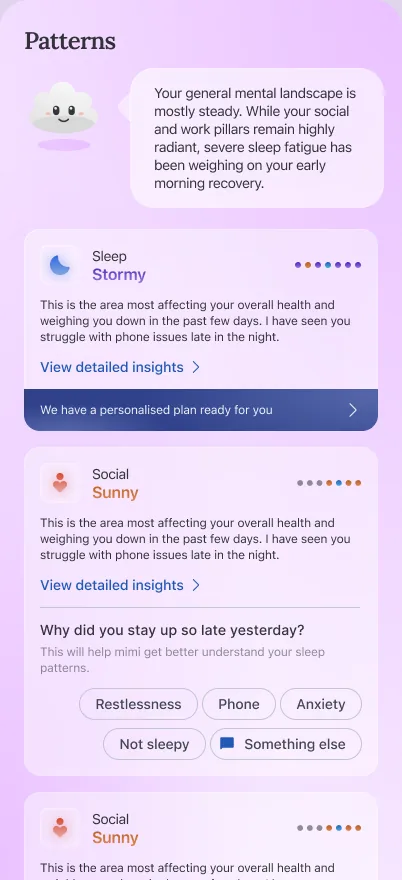
Every morning, Mimi's check-in shows whether your sky is clearing, and Patterns points out when overthinking tends to spike — Sunday evenings, after certain messages, late at night.
More on the techniques themselves: our overthinking guide and, in Hindi, overthinking kaise band kare.
Frequently asked questions
Can an app really help with overthinking?
An app can't think for you, but it can make the proven habits easier to keep: a daily worry window, a reminder to write the loop down, a two-minute breathing exercise when your mind races, and a record that shows when overthinking spikes. Consistency is what makes these techniques work, and that's what apps are good at.
Is meditation good for overthinking?
Mindfulness meditation helps many people notice thoughts without following them. But if sitting still with your thoughts makes them louder, start with more active techniques — breathing with a longer exhale, writing worries down, or a walk — and add meditation later.
What is the best free app for overthinking?
Mentis is free to download and includes a free daily check-in; Insight Timer has a large free meditation library. Some structured programs in most apps need a subscription.
- Borkovec TD et al. (1983). Stimulus control applications to the treatment of worry. Behaviour Research and Therapy 21(3).
- Watkins ER, Baeyens CB, Read R (2009). Concreteness training reduces dysphoria. Journal of Abnormal Psychology 118(1).
- Balban MY et al. (2023). Brief structured respiration practices enhance mood and reduce physiological arousal. Cell Reports Medicine 4(1).